Micro-ARP™
Ethical Decision-Point Application — A rapid ethical check for moments of uncertainty during AI-assisted professional work.
Overview
Micro-ARP is the rapid-application form of the ARP Framework, designed for individual decision points rather than entire workflows. Where ARP provides a continuous reflective cycle and AIRP adds structured checkpoints for AI-integrated environments, Micro-ARP condenses the same ethical reasoning into a quick internal check that can be performed in moments of uncertainty.
Professional practice is composed of hundreds of small decisions each day. Most of these decisions do not require a full reflective cycle — they are routine and the ethical implications are clear. But certain moments carry more weight: the decision to accept an AI-generated recommendation without modification, the choice to forward an AI-drafted communication to a client, or the moment when a practitioner realizes they are unsure whether an AI output is accurate.
Micro-ARP targets these inflection points. It provides practitioners with a rapid three-question framework that can be applied in seconds, creating a brief but meaningful pause between receiving an AI output and acting on it. This pause is often the difference between ethical practice and the gradual erosion of professional standards.
The Framework Model
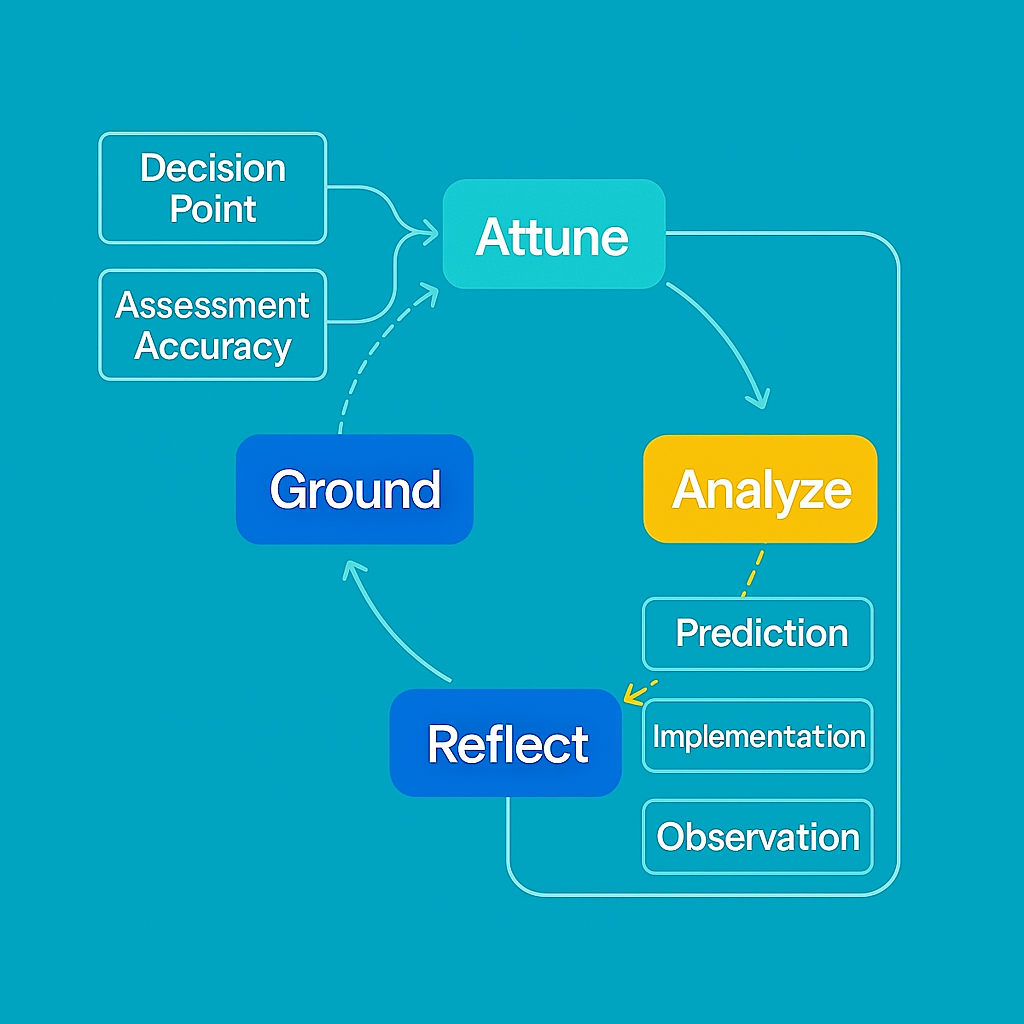
This diagram maps Micro-ARP as a moment-by-moment decision loop: professionals attune at a decision point, analyze inputs and predictions, reflect on observations and implementation, and ground before proceeding — reducing ethical drift in real time.
© Aluma
When This Framework Is Used
Micro-ARP is designed for the specific moments within a workday when a practitioner encounters uncertainty about an AI output. It is not a workflow-level framework — it operates at the level of individual decisions. A practitioner might use the full ARP cycle to structure their overall approach to AI-assisted documentation, but apply Micro-ARP at the specific moment when an AI-generated phrase seems clinically questionable.
Common trigger points include: receiving an AI recommendation that feels slightly off but is difficult to articulate why; being tempted to accept an AI output because revising it would take additional time; encountering an AI-generated assessment that introduces information or conclusions the practitioner did not provide; and moments when the practitioner realizes they have been approving AI outputs without reading them carefully.
Micro-ARP is particularly valuable during high-volume periods when practitioners are most vulnerable to efficiency pressure and most likely to defer to AI outputs without adequate evaluation.
Example Scenario
A child welfare caseworker is reviewing AI-generated summaries of home visit reports at the end of a long day. The AI tool compiles observations from multiple visits into a narrative summary for each case. The caseworker has been approving summaries efficiently, but pauses on one that characterizes a parent as "inconsistently engaged with services."
Notice: The caseworker recognizes that this characterization was generated by the AI based on attendance data, not on the caseworker's own assessment. The parent missed two appointments but had communicated about scheduling conflicts both times.
Evaluate: The caseworker considers whether "inconsistently engaged" accurately represents the situation. The label could influence custody evaluations, court reports, and other professionals' perceptions of this family. The attendance data alone does not capture the parent's actual engagement level.
Decide: The caseworker revises the summary to reflect the full context — noting the missed appointments alongside the parent's proactive communication — rather than accepting the AI's reductive characterization. The caseworker also goes back to review the three previous summaries they had already approved, recognizing that the same pattern of decontextualized labeling may have occurred.
Relationship to AI-Integrated Ethical Practice
Micro-ARP represents the most granular application of the ARP principles. If ARP is the daily practice and AIRP is the workflow-level integration, Micro-ARP is the moment-level intervention. Together, these three frameworks create a complete coverage model — from overall professional orientation to specific decision points.
Micro-ARP is the primary defense against Ethical Drift at the point where drift actually occurs: individual decisions. Ethical Drift does not happen in policy meetings or training sessions — it happens in the accumulation of small moments where a practitioner chooses convenience over deliberation. Micro-ARP targets exactly those moments, providing a lightweight but effective intervention that prevents individual decisions from compounding into systemic ethical erosion.
Key Takeaways
- Micro-ARP operates at the individual decision level, providing a rapid three-question check during moments of uncertainty.
- It is designed to be applied in seconds — a brief pause between receiving an AI output and acting on it.
- The three questions — Notice, Evaluate, Decide — condense the full ARP cycle into an actionable moment-level intervention.
- Micro-ARP is most valuable during high-volume work periods when efficiency pressure increases the risk of passive AI acceptance.
- The framework targets the exact moments where Ethical Drift begins: individual decisions to defer to AI without adequate evaluation.
- Combined with ARP and AIRP, Micro-ARP creates complete coverage from professional orientation to individual decision points.