ARP Framework™
Attune, Reflect, Protect — A three-phase reflective cycle for maintaining ethical awareness in professional practice.
Overview
The ARP Framework is the foundational reflective cycle within AI-Integrated Ethical Practice. It provides a structured three-phase process — Attune, Reflect, Protect — that helps practitioners maintain ethical awareness during professional workflows where AI tools are present.
ARP was developed in response to a consistent pattern observed across human services, healthcare, and education: when professionals integrate AI into their daily practice, the convenience and fluency of AI outputs can gradually replace deliberate ethical reasoning. Practitioners stop asking whether the AI's contribution is appropriate and begin assuming it is.
The framework does not require practitioners to reject AI assistance. Instead, it establishes a repeatable cycle that keeps human judgment active and primary. Each phase serves a distinct function — awareness of context, evaluation of implications, and preservation of professional boundaries — creating a continuous loop rather than a one-time checklist.
The Framework Model
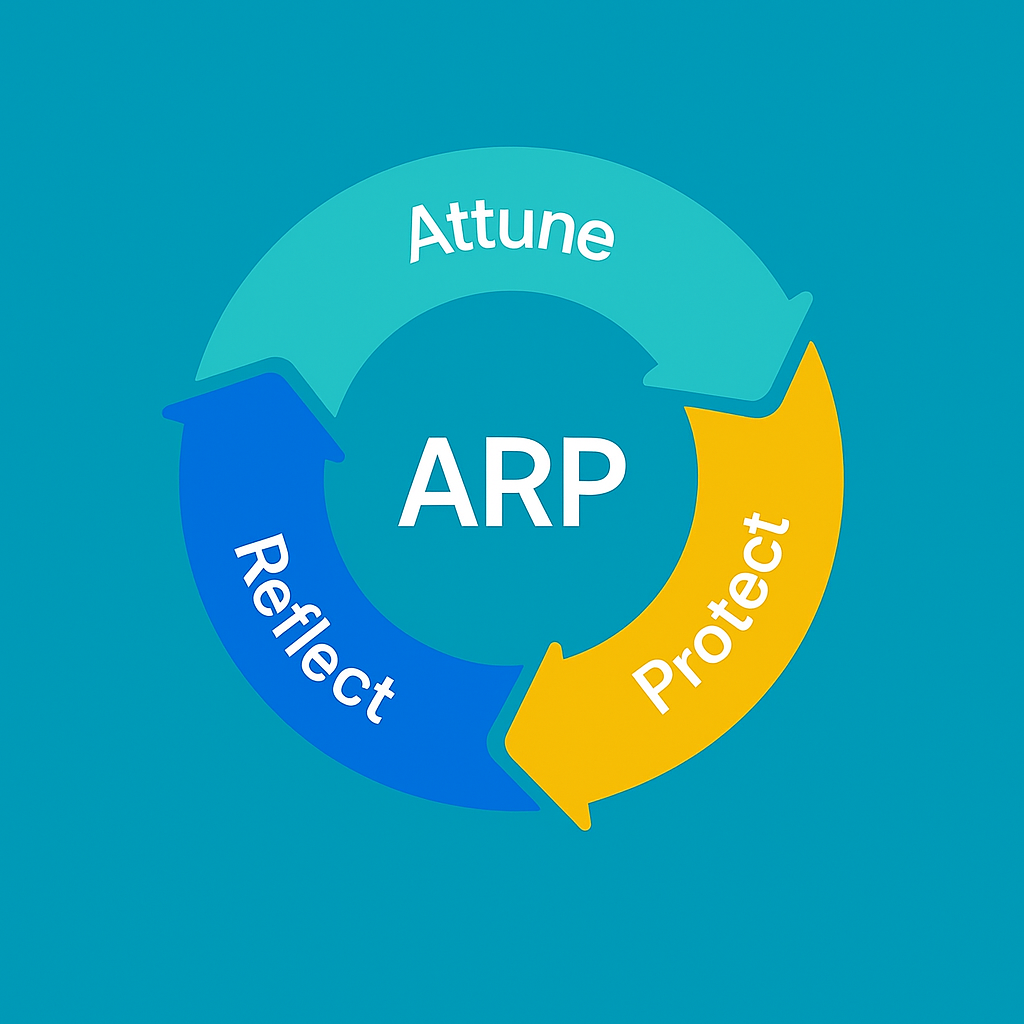
This diagram illustrates ARP as a continuous loop — attunement informs reflection, reflection informs protection, and protection resets ethical awareness for the next decision.
© Aluma
When This Framework Is Used
The ARP Framework is applied whenever practitioners need to maintain active ethical awareness during AI-assisted workflows. It is particularly relevant in situations where AI tools generate content, recommendations, or analyses that a professional must evaluate before acting on.
Common applications include clinical documentation where AI drafts case notes, educational settings where AI suggests student interventions, social service environments where AI assists with risk assessments, and healthcare contexts where AI contributes to treatment planning. In each case, the practitioner uses the Attune-Reflect-Protect cycle to ensure their professional judgment remains the primary driver of decisions.
ARP is designed for ongoing use — not as a one-time training exercise but as a habitual practice that becomes part of how professionals engage with AI tools throughout their workday.
Example Scenario
A school social worker uses an AI tool to draft progress notes after a session with a student experiencing family instability. The AI generates a well-structured note that includes clinical language about the student's emotional state and recommends continued monitoring.
Attune: The social worker pauses to notice that the AI's note characterizes the student's affect as "flat" — a clinical descriptor the social worker did not use during the session. The student was quiet, but the social worker observed engagement through nonverbal cues.
Reflect: The social worker considers whether adopting the AI's language would misrepresent the session. Using "flat affect" in the official record could influence how other professionals perceive the student and what interventions are recommended next.
Protect: The social worker revises the note to reflect their own clinical observation — "student was quiet but demonstrated engagement through eye contact and nodding" — preserving the accuracy of the professional record and protecting the student from a potentially misleading characterization.
Relationship to AI-Integrated Ethical Practice
ARP serves as the core reflective cycle within the broader AI-Integrated Ethical Practice framework system. While AIRP extends this cycle specifically for AI-integrated environments and Micro-ARP condenses it for rapid decision points, ARP provides the foundational rhythm that all other frameworks build upon.
The diagnostic concepts of Ethical Drift, Constructive Assumption Error, Unwarranted Expansion, Affective Echo, and Framing Distortion describe the risks that ARP is designed to counteract. The safeguard principles — Ethical Expansion Constraints and Reflective Human-in-the-Loop Practice — describe the boundaries that ARP helps practitioners maintain. Together, these elements form a coherent system where ARP is the active practice that keeps the entire architecture functioning.
Key Takeaways
- ARP is a continuous reflective cycle, not a one-time checklist — it is meant to be practiced habitually.
- The three phases — Attune, Reflect, Protect — address awareness, evaluation, and boundary preservation respectively.
- ARP does not require rejecting AI tools; it requires maintaining active professional judgment alongside them.
- The framework is applicable across disciplines including social work, healthcare, education, and legal services.
- ARP counteracts Ethical Drift by ensuring practitioners do not passively accept AI outputs without critical evaluation.
- Consistent use of ARP builds the reflective capacity that makes all other framework components effective.