AIRP Framework™
AI-Integrated Reflective Practice — Extending ARP with structured checkpoints for environments where AI actively participates in professional workflows.
Overview
The AIRP Framework extends the foundational ARP cycle specifically for environments where AI is not merely available but actively integrated into professional workflows. While ARP provides the core reflective rhythm of Attune, Reflect, and Protect, AIRP adds structured evaluation checkpoints at the moments where AI outputs enter the professional decision-making process.
In many professional settings, AI has moved beyond being an optional tool. It generates draft documentation, suggests risk scores, proposes treatment plans, and synthesizes client information. AIRP recognizes that this level of integration creates unique ethical challenges that general reflective practice cannot adequately address. When AI participates in the work rather than merely supporting it, practitioners need explicit moments to evaluate whether the AI's contribution is appropriate, accurate, and within scope.
AIRP does not slow workflows unnecessarily. Its checkpoints are designed to integrate naturally into the points where practitioners already review AI outputs — the moment before approving a draft, accepting a recommendation, or forwarding an AI-generated analysis. The framework transforms these routine moments into deliberate acts of professional judgment.
The Framework Model
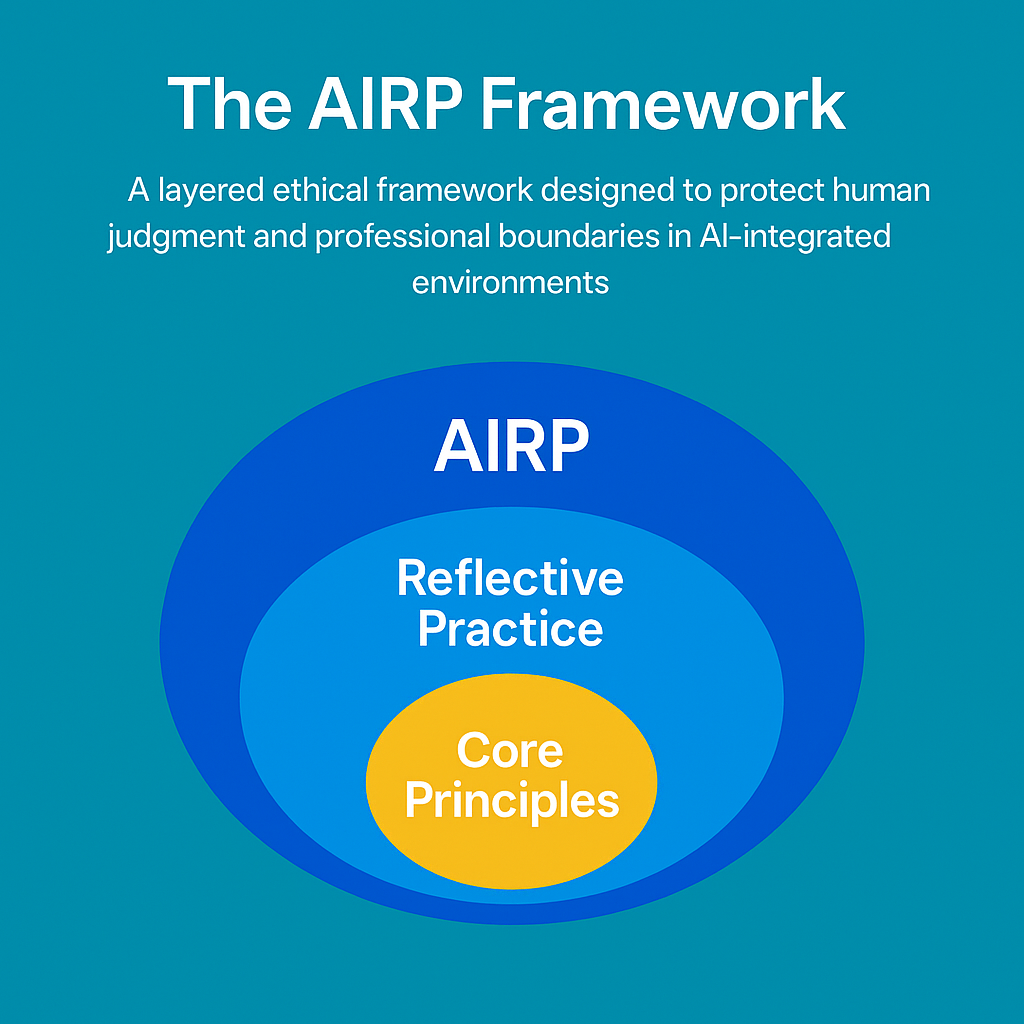
The concentric structure shows how core ethical principles are held at the center, surrounded by reflective practice, and carried outward into AI-integrated environments — ensuring judgment remains anchored at every layer.
© Aluma
When This Framework Is Used
AIRP is applied in environments where AI actively participates in documentation, analysis, or decision support — not as a background tool but as a contributor to professional outputs. This includes clinical settings using AI-assisted documentation systems, educational environments where AI generates student progress analyses, and social service agencies where AI tools contribute to case assessments.
The framework is particularly important when AI outputs are fluent enough to be accepted without scrutiny. Modern language models produce text that reads as competent and authoritative, making it easy for practitioners to approve AI-generated content without evaluating whether it accurately represents their professional observations. AIRP creates the structured pause that prevents this passive acceptance.
Organizations implementing AI documentation tools, AI-assisted screening instruments, or AI-generated reporting should adopt AIRP as part of their standard workflow to ensure that efficiency gains do not come at the cost of professional accountability.
Example Scenario
A mental health counselor uses an AI-integrated documentation platform that listens to session recordings and generates structured clinical notes. After a session with a client dealing with workplace harassment, the AI produces a comprehensive note that includes a preliminary assessment suggesting the client may benefit from assertiveness training.
Attune: The counselor recognizes that the AI has moved beyond documentation into clinical recommendation — suggesting an intervention approach rather than simply recording what occurred in the session.
AI Checkpoint: The counselor evaluates this recommendation against their clinical knowledge. The client is experiencing workplace harassment — a systemic issue. Suggesting assertiveness training could inadvertently place responsibility on the client for their own victimization, a well-documented clinical concern.
Reflect: The counselor considers whether including this recommendation, even as a suggestion, could influence treatment direction in ways that don't serve the client's actual needs. They determine that it represents a scope expansion by the AI tool.
Protect: The counselor removes the recommendation from the note, retains the factual documentation, and records their own clinical assessment that focuses on environmental and systemic factors rather than individual behavioral change.
Relationship to AI-Integrated Ethical Practice
AIRP occupies a critical middle position in the framework architecture. It builds directly on the ARP cycle by adding the AI-specific evaluation layer that contemporary professional environments require. Where ARP provides general reflective capacity, AIRP applies that capacity to the specific challenges created by AI integration.
AIRP is closely connected to the safeguard principles of Ethical Expansion Constraints and Reflective Human-in-the-Loop Practice. The AI Checkpoint phase is where practitioners actively apply these principles — evaluating whether the AI has expanded beyond its appropriate scope and ensuring that human engagement is reflective rather than merely procedural. AIRP makes the theoretical protections of the framework system operational in daily practice.
Key Takeaways
- AIRP extends the ARP cycle with structured AI evaluation checkpoints for environments where AI actively contributes to professional work.
- The AI Checkpoint phase transforms routine output review into deliberate professional judgment.
- AIRP is essential when AI generates content that could be accepted without scrutiny due to its fluency and apparent competence.
- The framework integrates naturally into existing workflows at the points where practitioners already interact with AI outputs.
- AIRP operationalizes the safeguard principles of Ethical Expansion Constraints and Reflective Human-in-the-Loop Practice.
- Organizations deploying AI documentation or decision-support tools should adopt AIRP as part of their standard operating procedures.