Messy Ethics/Intelligent Care · AI, ethics & humanity
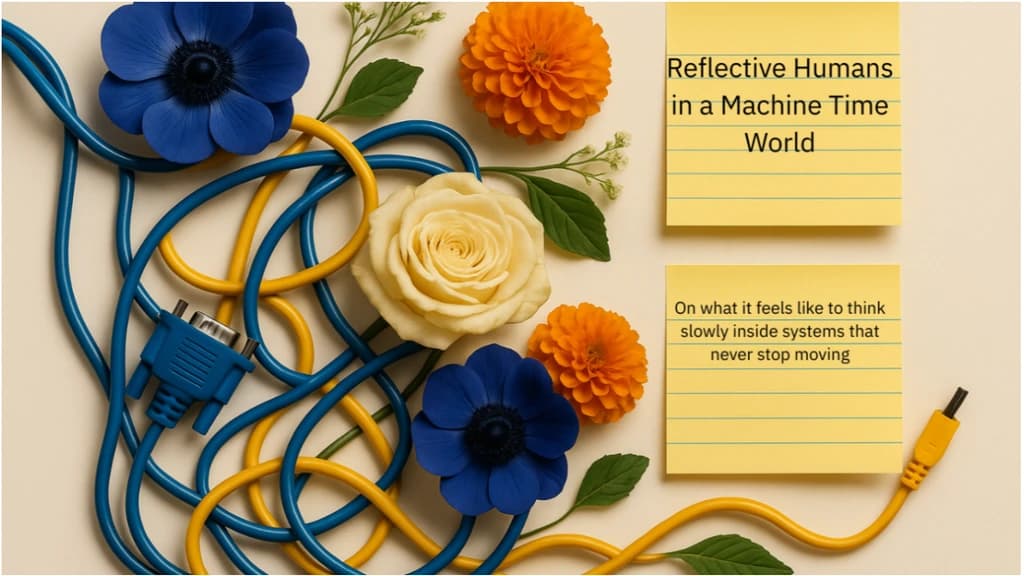
Reflective Humans in a Machine Time World
On what it feels like to think slowly inside systems that never stop moving
By Ashleigh Gardner-Cormier, LMSW · Originally published
There is a particular kind of exhaustion that does not come from working too long. It comes from working too fast for too long.
Not physical speed, but temporal speed.
Decision follows decision with no space to register what just happened. Over time, that compression changes how thinking feels. Many people do not notice the shift as it occurs. They only notice that something has gone quiet. Not the noise, but the pause. The internal check that once slowed things down just enough to notice doubt, uncertainty, or alternative paths.
Machine time does not arrive as pressure. It arrives as momentum. And momentum is harder to resist.
THE MOMENT THAT USED TO BE YOURS
There was once a brief moment between stimulus and response that belonged to the practitioner. Often it was barely perceptible. A breath. A half second of hesitation. An internal question that surfaced before action.
Is this right? Am I missing something? Is there more here than what the screen shows?
That moment has not disappeared because people care less. It has narrowed because systems do not wait.
The workflow advances. The form timestamps. The queue refreshes.
Without instruction or force, machine time begins to shape how movement is expected to occur.
WHAT IT FEELS LIKE TO FALL BEHIND A SYSTEM
No one tells you when you fall out of sync with your own judgment. You simply begin to feel behind.
Behind alerts, quotas, response windows, and metrics that define adequacy. Gradually, thinking starts to feel inefficient. Pausing feels risky. Reflection begins to register as something optional, even indulgent.
The internal language shifts quietly.
I will think about that later. This is good enough. The system already decided.
None of these statements sound unethical. And yet something ethical is being displaced.
HOW MACHINE TIME NORMALIZES SPEED
Systems rarely demand value violations outright. They normalize them.
Throughput becomes a marker of virtue. Responsiveness becomes evidence of professionalism. Compliance becomes a stand in for care.
Speed is rewarded so consistently that anything slower begins to feel irresponsible. Even concern becomes compressed. Even grief is given a time slot.
WHEN HUMANS ADAPT
Humans adapt quickly. That is not a strength in this context. It is the risk.
We adjust our expectations and internal thresholds. We stop noticing when decisions feel less intentional. We stop naming the loss of deliberation. Over time, many come to believe this is simply how work functions now.
What is being trained is not efficiency. It is obedience to pace. To urgency. To uninterrupted system momentum.
A SLOWER FORM OF INTELLIGENCE
Some forms of intelligence cannot be rushed.
They move at the speed of moral uncertainty, conflicting obligations, incomplete information, and human vulnerability. They rarely arrive with confidence. More often, they show up as discomfort.
A question that lingers after the decision. A feeling that resurfaces later. An unease that has not yet found language.
Machine time cannot accommodate this kind of intelligence. It cannot measure it or accelerate it. So it quietly teaches us to move past it.
WHAT IS LOST WITHOUT THE PAUSE
When reflective humans operate entirely inside machine time, the loss is not just slowness.
We lose our relationship to consequence. We lose comfort with ambiguity. We lose the ability to interrupt ourselves.
We lose the courage to say something does not sit right and to remain with that feeling long enough to understand why.
That capacity cannot be automated. But it can be crowded out.
CLOSING
The most significant shift unfolding in intelligent systems is not computational. It is temporal.
We are being asked to think at the speed of systems that do not carry responsibility. Responsibility, however, has always moved more slowly.
The future of intelligent care will not be decided by how fast our systems become. It will be decided by whether reflective humans are still permitted to move at the speed of moral weight.